- Topics
- Webinars
- Products & Services

Welcome To Biggest Online compliance Platform By LOCGFX Pvt. Ltd.


Human Resource & Payroll
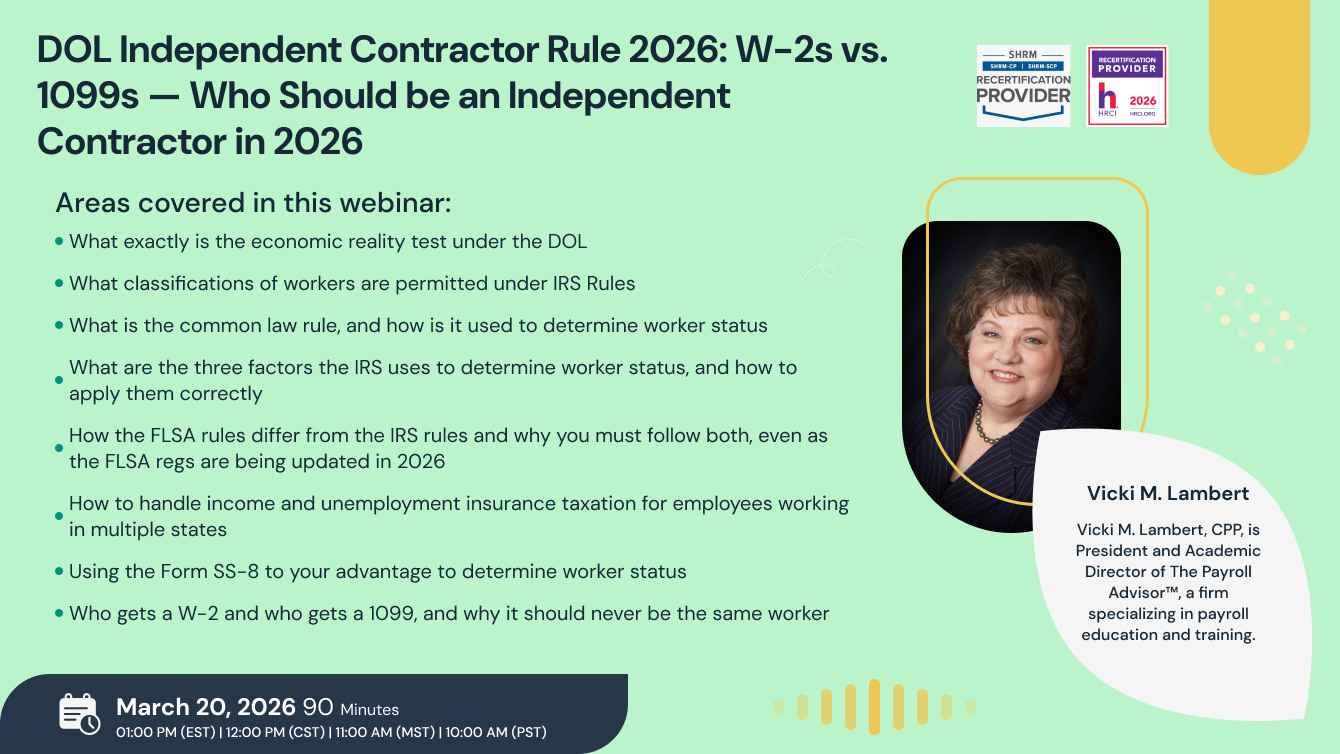
The U.S. Department of Labor (DOL) has issued a significant 2026 proposed rule regarding Independent Contractor classification under the Fair Labor Standards Act (FLSA). This proposal rescinds the 2024 rule and reintroduces a revised economic reality framework that may substantially impact how businesses classify workers as employees or independent contractors.
HR leaders cannot confidently classify workers as employees or independent contractors because the federal standard keeps changing — and misclassification carries severe financial and legal consequences.
This webinar provides a comprehensive breakdown of the 2026 proposal, key differences from prior rules, compliance risks, and practical steps organizations should take to mitigate worker misclassification exposure.
What just recently announced (02-26-2026), new (or old) criteria is the DOL now using to determine worker status
· What exactly is the economic reality test under the DOL
· What classifications of workers are permitted under IRS Rules
· What is the common law rule, and how is it used to determine worker status
· What are the three factors the IRS uses to determine worker status, and how to apply them correctly
· How the FLSA rules differ from the IRS rules and why you must follow both, even as the FLSA regs are being updated in 2026
· How does the state trump both the IRS and the FLSA on determining independent contractor status with the ABC test for SUI
· What are the latest agreements or programs being used by the IRS, DOL, and the states to “find” misclassified employees
· Using the Form SS-8 to your advantage to determine worker status
· Who gets a W-2 and who gets a 1099, and why it should never be the same worker
This webinar is essential for anyone responsible for worker classification, workforce flexibility, or compliance strategy:
· Business owners and executives - If your company relies on independent contractors, gig workers, or consultants, you need to understand how the proposed rule could affect your business model and risk exposure.
· HR professionals and HR business partners - If you are responsible for classifying workers, drafting contractor agreements, conducting audits, or advising leadership on compliance risk.
· General counsel and compliance leaders - If you need to evaluate litigation exposure and understand how the proposed “core factors” test differs from the 2024 rule.
· Payroll and workforce administration professionals - If worker classification impacts overtime eligibility, recordkeeping, tax reporting, or FMLA determinations.
· Staffing, franchise, and contractor-heavy employers - If your organization depends on flexible workforce structures, and you need clarity on what the DOL’s proposed rule means for your operations.
· Managers and operational leaders who engage contractors directly - If you supervise or work alongside independent contractors and need to understand how control, profit opportunity, and actual practice affect classification status.
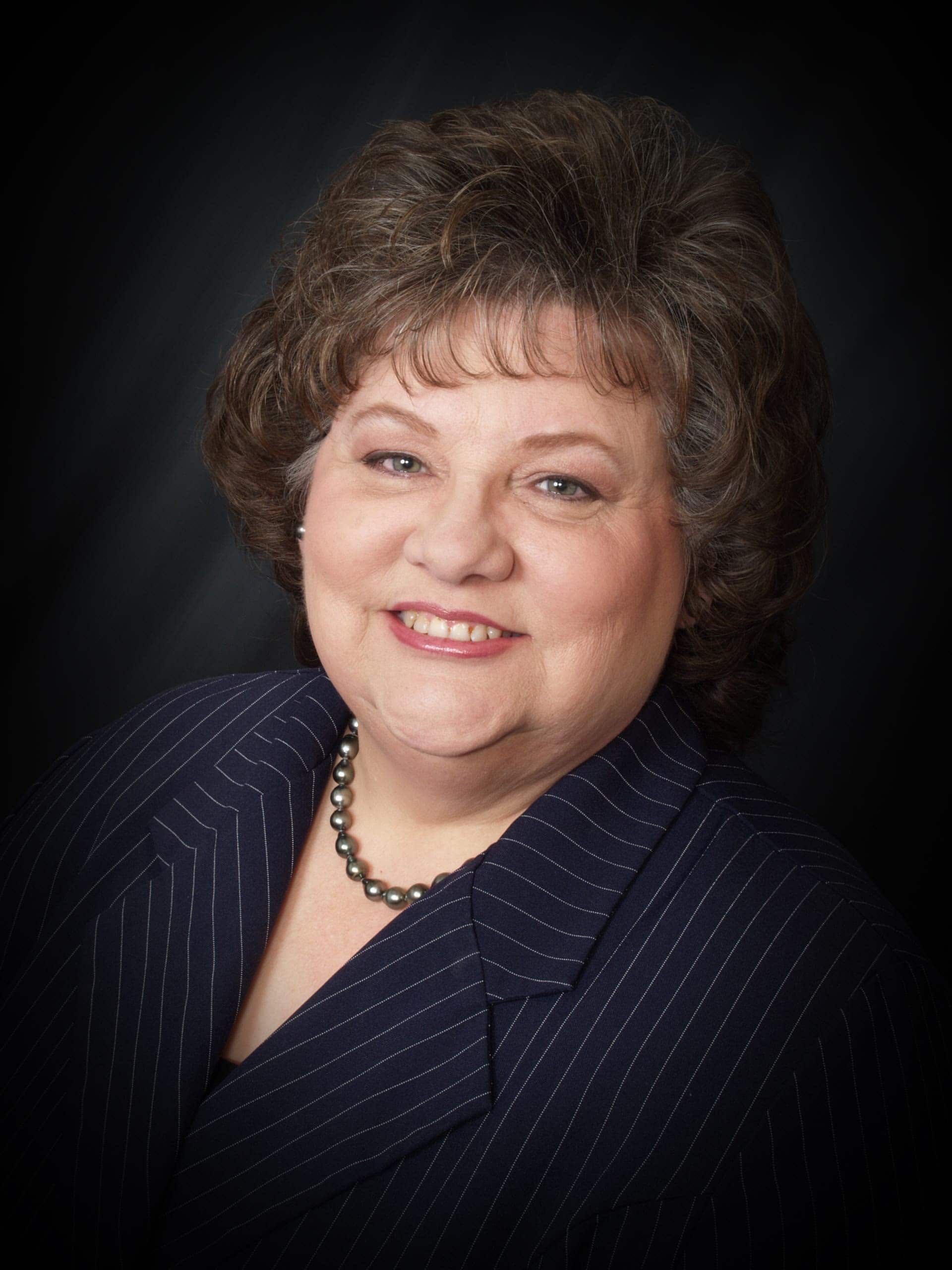
Vicki M. Lambert, CPP,
is President and Academic Director of The Payroll Advisor™, a firm specializing
in payroll education and training. The company’s website www.thepayrolladvisor.com offers a payroll news
service which keeps payroll professionals up-to-date on the latest rules and
regulations.
With nearly 40 years of hands-on experience in all facets of payroll
functions as well as over three decades as a trainer and author, Ms. Lambert
has become the most sought-after and respected voice in the practice and
management of payroll issues. She has
conducted open market training seminars on payroll issues across the United
States that have been attended by executives and professionals from some of the
most prestigious firms in business today.
A pioneer in electronic and online education, Ms.
Lambert produces and presents payroll-related audio seminars, webinars, and
webcasts for clients, APA chapters, and business groups throughout the country.
Ms. Lambert is an adjunct faculty member at Brandman University in Southern
California and is the creator of and instructor for their Practical Payroll
Online program, which is approved for recertification hours by the APA. She is
also the instructor for the American Payroll Association’s “PayTrain” online program
also offered by Brandman University.

Compliancevent is recognized by SHRM to offer Professional Development Credits (PDCs) for the SHRM-CPSM or SHRM-SCPSM. This program is valid for 1.5 PDCs for the SHRM-CPSM or SHRM-SCPSM. For more information about certification or recertification, please visit - portal.shrm.org.

This webinar has been approved for 1.5 HR (General) re-certification credit hours toward California, GPHR, HRBP, HRMP, PHR, and SPHR recertification through the HR Certification Institute.
The use of this seal is not an endorsement by the HR Certification Institute of the quality of the activity. It means that this activity has met the HR Certification Institute’s criteria to be pre-approved for re-certification credit.
Sign up now on compliancevent.net. Visit compliancevent.net/webinar to discover a wide range of webinars from industry specialists. Tick on either ‘live webinar’ or ‘on-demand’, and simply click on ‘buy now’ to get enrolled.
You can refer compliancevent to anyone in your social circle. Explore your industry with your colleagues by getting them signed up on compliancevent.net today!
Go for the topic of your keen interest on compliancevent.net. Tick on ‘live webinar’ and get enrolled! Easy registration, transparent transaction.
You can request for an on-demand webinar that records the live webinar for you. After the webinar ends, you will have full access to the webinar’s recording. You can also explore compliancevent offline to order your webinar DVDs, flash drives and transcripts.
If you can’t attend the live webinar, simply go for the ‘on-demand webinar’ for the same price! Now, the live webinar recording will be saved in a cloud storage for you to access anytime from anywhere.
compliancevent offers both hard and soft copies of the webinars. It contains all the highlights as well as comprehensive descriptions of the webinar, so you never miss out a single detail.
After attending the live webinar, your certificate will be emailed to you. You can download it and add more charm to your professional score.
At the end of each webinar, you have the opportunity to interact with your industry experts, where you will get answers to all your queries.
Can’t attend the live webinar? compliancevent has got you covered! You can always switch to the on-demand webinar from your portal. You can also get your hands on the webinar’s DVD/flash drive and transcript. So order them now!
compliancevent brings a variety of options for offline learning. Order your DVDs, flash drives or transcripts now to have a lifetime access to compliancevent webinars. You can also go for on-demand recordings. Download and watch it anytime from anywhere in the world!